
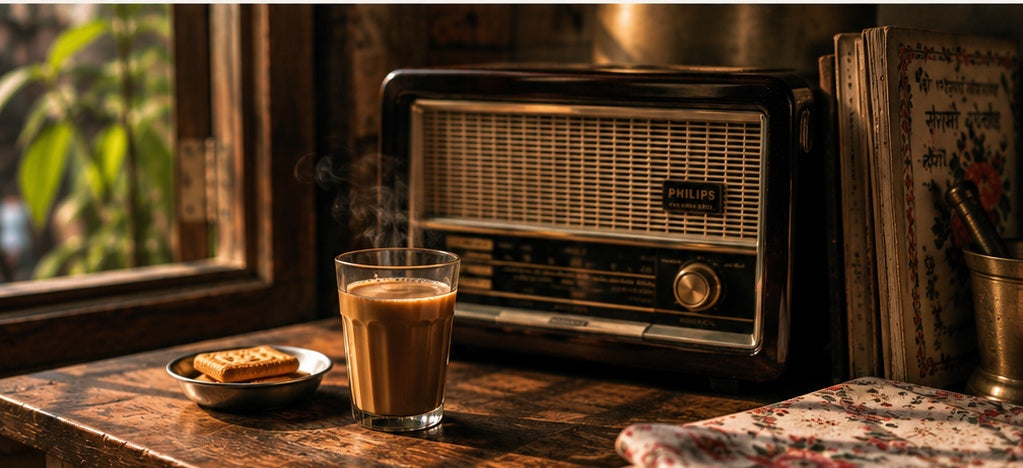
Before playlists and podcasts, there was often a small radio somewhere near the kitchen, filling the room with film songs, familiar voices and the occasional crackle of distance.
The day in an Indian home rarely begins with silence. A pressure cooker gathers itself on the stove. Steel tumblers touch the counter. Somebody folds yesterday’s newspaper into a smaller, more manageable shape. And for generations, another sound often sat underneath all of it: the radio.
Vividh Bharati was launched by All India Radio in 1957, with popular film music at the centre of its programming. It was created at a time when radio was not simply something you listened to. It lived with you. It travelled from the bedroom to the kitchen, from the morning rush to the slower hour after lunch, and from one generation’s habits into the next.
A soundtrack rather than an event
The most interesting thing about radio in the home was how little ceremony it required. Nobody needed to gather around it. It could be switched on while onions browned, uniforms were ironed or chai simmered. Music entered the room without asking everyone to stop what they were doing.
Vividh Bharati became especially known for a mix of film music, short plays and programmes such as Hawa Mahal, Bhoole Bisre Geet, Jaimala and Sangeet Sarita. The names themselves became part of the rhythm of the day. You did not necessarily make time for them. They arrived while life was already happening.

That background quality is part of what made it intimate. A song heard repeatedly while breakfast was being made can become attached to a room more firmly than a song deliberately chosen years later. Memory is often built this way, without announcing itself.
The kitchen had its own listening culture
There was also something particular about the kitchen as a place for radio. Unlike television, it did not demand a line of sight. Unlike a record player, it did not need constant attention. It could sit on a shelf above the spice tins or beside the window and simply keep someone company.
That mattered in homes where domestic work could be repetitive and solitary. The radio brought in actors, singers, announcers, news, drama and music without changing the shape of the room. The listener could keep chopping, stirring, washing or making chai. The outside world came in, but the home remained itself.
Even the slight imperfections were part of it. A station drifting. A voice briefly swallowed by static. A hand reaching over to adjust the dial. These were small acts of listening that have largely disappeared from a world of instant search and perfect playback.
Still there, just quieter
Vividh Bharati is still broadcast today, including through FM and online streaming. The technology has moved on, but the emotional logic of it feels familiar. We still want something playing while we cook. We still attach songs to kitchens, journeys and particular hours of the day. We still find comfort in voices that return regularly.
The difference is that we now choose almost everything. The old radio chose some of it for us. A song you had forgotten could arrive without invitation. A programme could begin because it was four o’clock, not because an algorithm had decided you might like it.
Perhaps that is why the memory of a radio in the kitchen can feel so specific. It was never the main event. It was simply there, beside the clatter of steel, the newspaper, the smell of breakfast and a cup of chai going slightly cold because somebody had become distracted by a song.
