
Ghar Ki Chai did not begin with a polished business plan. It began with a cup that was not quite right.
After moving to the UK, recreating proper Indian chai often meant assembling tea, milk, sugar and several spices every time. The ritual was worth it, but it was not always practical. During lockdown, with daily life compressed into the home, the question became irresistible: could a genuinely satisfying cup be made much more simply?
The kitchen became the test lab
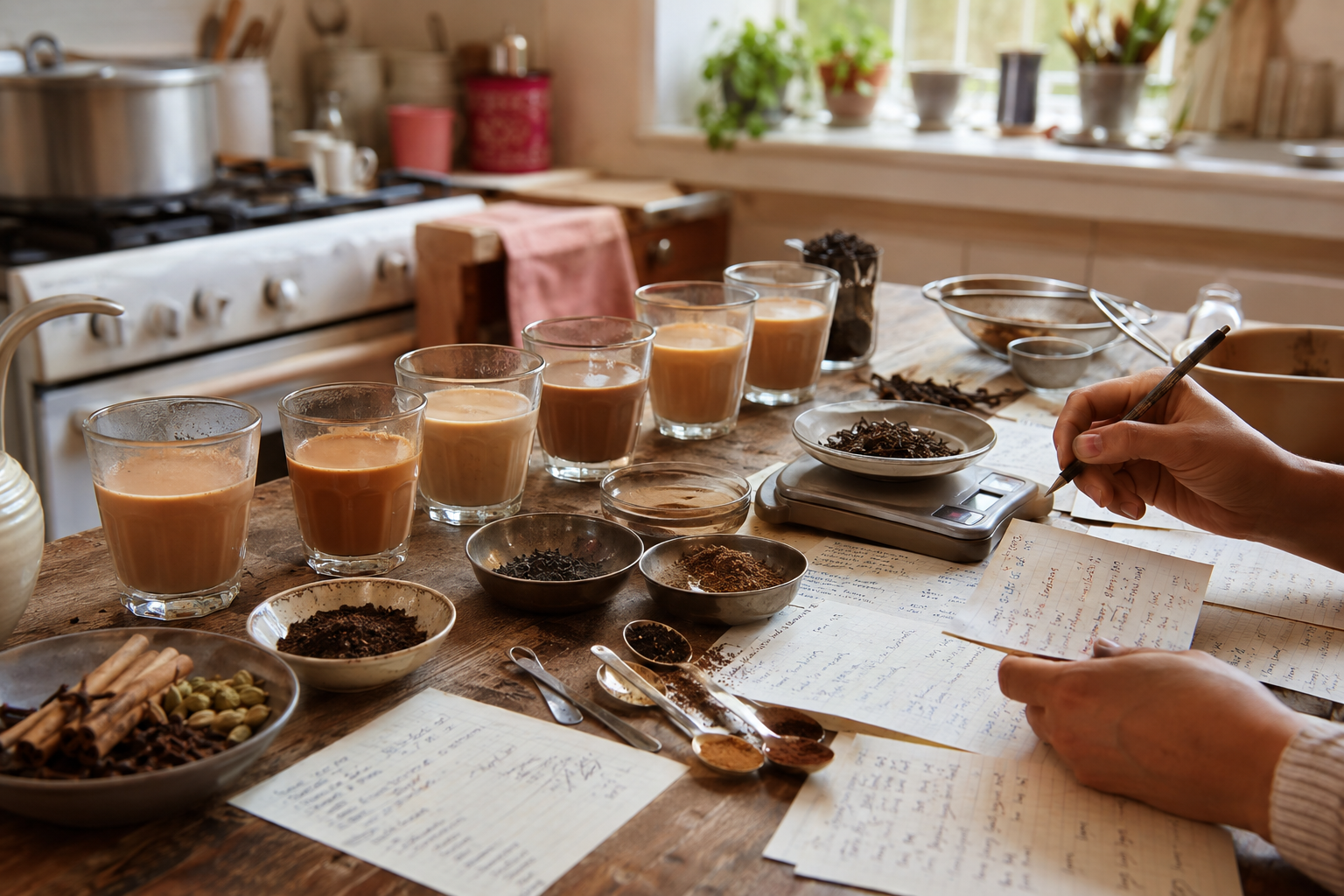
Early batches were made in small quantities and judged one cup at a time. Some had too much ginger. Some smelled wonderful but tasted flat. Others worked in one serving and became unbalanced when scaled up.
The work was less glamorous than the finished packets suggest: weighing, stirring, tasting, changing one variable and beginning again. Friends and family became unofficial testers. Their feedback was often direct - which is exactly what a new blend needs.
Convenient could still feel authentic
The goal was never to replace the slow cup made from scratch. It was to create a dependable alternative for the mornings, office breaks and late afternoons when time is short but ordinary tea will not do.
That meant refusing the idea that convenience had to taste generic. The tea still needed body. The spices needed warmth rather than dustiness. Each flavour needed a clear personality.
From one blend to a family of flavours
Masala created the foundation: balanced, comforting and recognisably Indian. Adrak turned up the ginger. Sulaimani offered a lighter black-tea ritual. Vegan, Chocolate and Kashmiri Kahwa opened other doors.
What began as a search for home became a way to share it.
What stayed after lockdown
The circumstances that started the experiments disappeared, but the problem they were trying to solve did not. We still wanted chai that could fit into a weekday without losing the warmth, spice and familiarity that made the ritual matter.
That tension - between ease and character - became the idea we kept returning to. The kitchen experiments were never really about making chai faster for its own sake. They were about making it easier to reach for a cup that still felt like home.
Ghar Ki Chai has grown since those first experiments, but the method remains familiar: make, taste, listen and improve. Every new product still has to pass the original test. When the cup is ready, does it feel like chai you would be happy to serve in your own ghar?
